PAT
Pointing, Acquisition, and Tracking (PAT)
Pointing, Acquisition, and Tracking (PAT) is a core function of the Optical Communications Terminal (OCT), responsible for establishing and maintaining precise inter-satellite optical links.
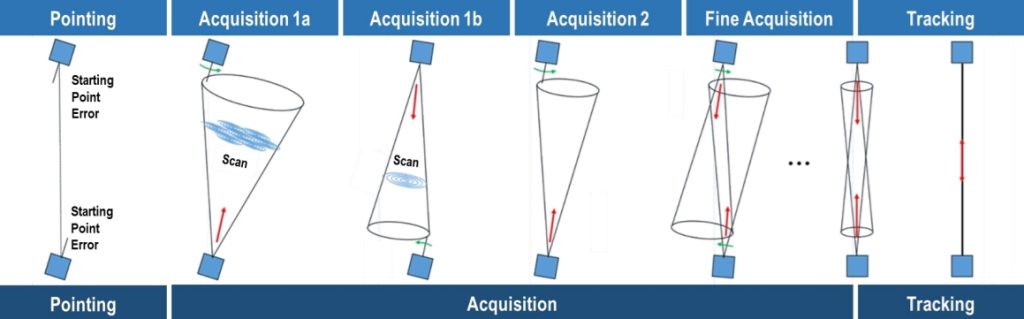
According to the SDA OCT standard, the PAT process consists of six phases: Pointing, Acquisition 1A, Acquisition 1B, Acquisition 2, Fine Acquisition, and Tracking. Through phased beam scanning, signal acquisition, and closed-loop tracking, the system progressively reduces pointing uncertainty between terminals to establish a stable optical communication link. The PAT system is designed to minimize link acquisition time and maximize the available communication window.
PAT System Architecture
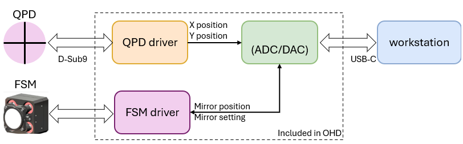
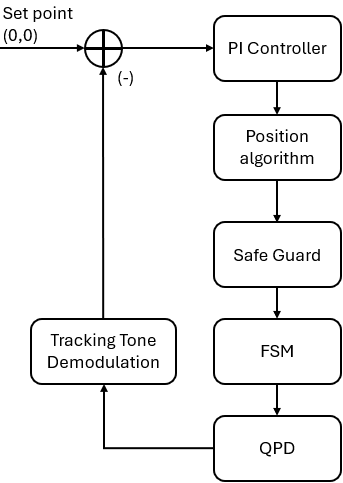
The PAT system integrates a Quadrant Photodetector (QPD), Fast Steering Mirror (FSM), and associated driving and control electronics to enable precise beam alignment and tracking. The QPD detects beam position and provides X/Y position signals, which are processed through tracking-tone demodulation to generate pointing error feedback. A Proportional-Integral (PI) controller calculates correction commands, while the position algorithm and safety safeguards regulate FSM movement. This closed-loop control architecture continuously compensates for pointing errors to maintain stable optical beam alignment and tracking.
QPD–FSM Closed-Loop Response Simulation
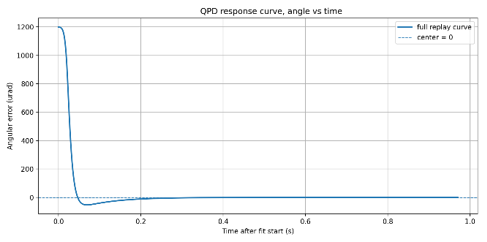
To support PAT control development, OptiFab performs closed-loop response simulations for the QPD–FSM tracking system. The simulation evaluates how the control loop responds to an initial angular pointing error and corrects it through feedback control.
In the example shown, an initial pointing error of approximately 1200 µrad is rapidly reduced to near zero, with only a small transient overshoot before settling. The result demonstrates the feasibility of the closed-loop tracking architecture for beam alignment and error correction.